
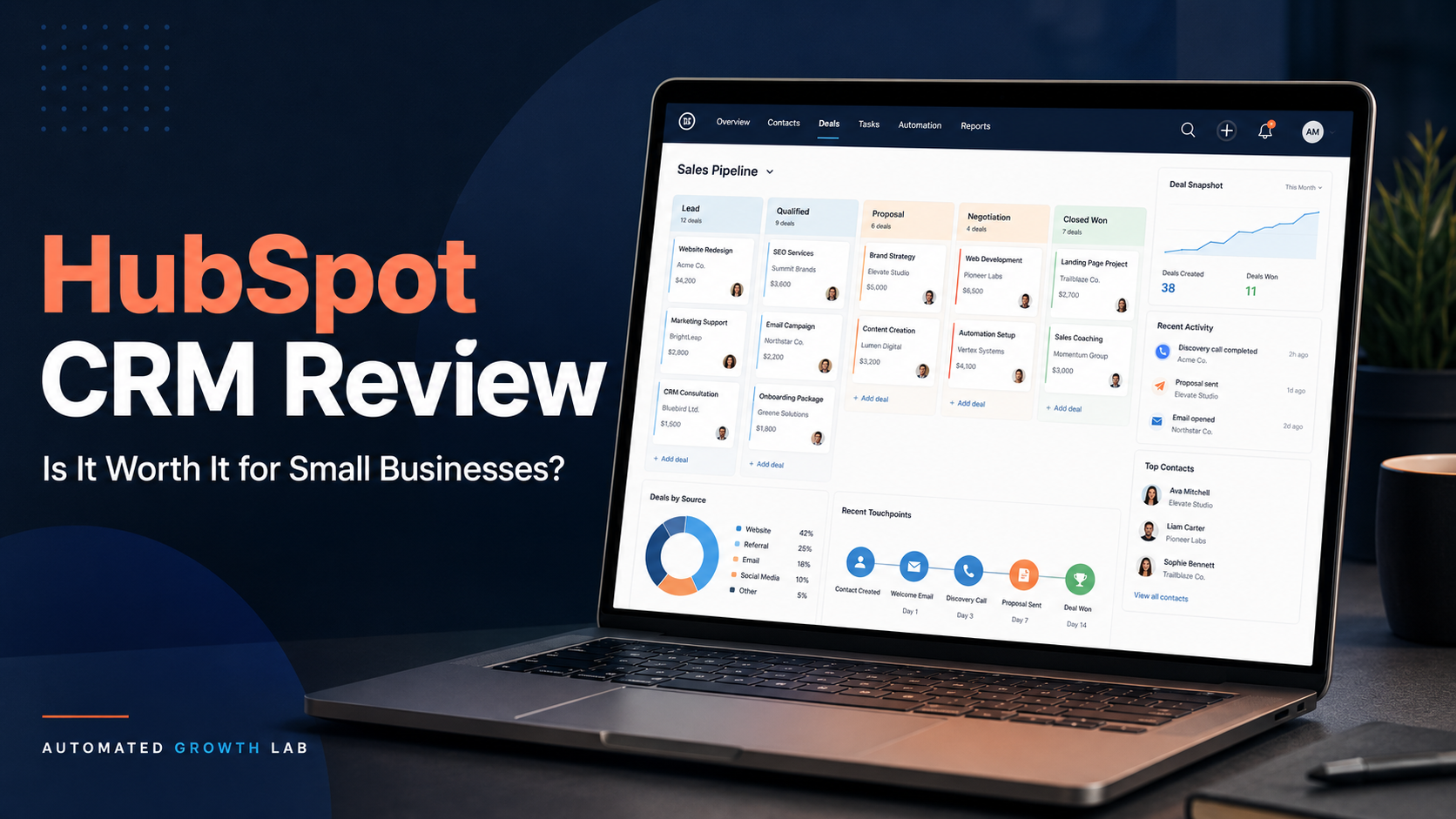
Automated Growth Lab may earn a commission from some of the links in this article, at no additional cost to you. We only recommend tools we believe genuinely help small businesses. Our ratings and recommendations are based on independent research and hands-on testing. Read our full affiliate disclosure.
Last updated: August 9, 2026 · Reading time: about 18 minutes · Pricing verified: August 8, 2026
Quick Verdict
Recommendation: Recommended With Caveats
HubSpot is a strong choice for solo operators and small teams that want a capable free CRM with room to grow. In our hands-on testing, the free plan handled contact management, deal tracking, forms, meetings, and the everyday work of a small sales pipeline without much friction.
The main drawback is the upgrade path. HubSpot offers affordable simple automation through its Starter options, but advanced workflows, conditional logic, and customized automation require higher-priced plans. That can turn HubSpot into a much larger financial and operational commitment than a small business initially expects.
We tested HubSpot’s free plan directly in August 2026. Paid features that were unavailable during testing were evaluated using HubSpot’s official documentation. Throughout this HubSpot CRM review, we distinguish between what we tested ourselves and what HubSpot documents.
Automated Growth Score™: 8.2/10
Calculated using Automated Growth Lab’s proprietary review framework, which evaluates beginner friendliness, AI capabilities, automation power, ease of use, integrations, and value for money.
The Automated Growth Score™, category by category
| Category | Score |
|---|---|
| Beginner Friendly | 8.8 |
| AI Features | 7.3 |
| Automation Power | 7.6 |
| Ease of Use | 8.6 |
| Integrations | 8.8 |
| Value for Money | 8.4 |
| Overall | 8.2 |
Here is the short version of why each category landed where it did. The detailed reasoning follows in the sections below.
Beginner Friendly (8.8). A new free account was ready in about ten minutes with clear onscreen guidance, and the core actions were easy to learn. A couple of menu locations are not obvious at first.
AI Features (7.3). The free Breeze Assistant drafted a usable follow-up email in our testing. The paid AI agents that do the heavier work run on a credit system we did not exercise, so that part of the score rests on documentation.
Automation Power (7.6). HubSpot documents strong workflow capability: triggers, conditional logic, multi-step workflows, and scalability, though we did not test the paid workflows. Free includes one simple automated email per form, the low-cost Starter tier adds more actions, and advanced custom workflows need Professional. In testing we did not complete the free email workflow through the route we used, and customized automation produced a Professional prompt.
Ease of Use (8.6). Once you learn the layout, day-to-day operation is smooth, and a single record view keeps contact, company, and activity together.
Integrations (8.8). Email and calendar connected cleanly, export worked, and the wider ecosystem is large. One free-plan gap showed up in testing, covered below.
Value for Money (8.4). The free tier delivers clear value, and there is a cheap Starter entry point. The jump to advanced or customized automation is where cost climbs sharply.
The six weighted category scores produce 8.225. After weighing intended-reader fit, implementation likelihood, total cost, risk, limitations, and alternatives, Dan Saunders approves an Overall Automated Growth Score™ of 8.2. The rating is Recommended With Caveats because the fit is conditional.
Who HubSpot CRM is best for
- Solo operators and two-person teams who want to organize contacts, track deals, and log activity without paying for software yet.
- Small businesses replacing a spreadsheet who need a real pipeline, task reminders, and a shared record of every customer conversation.
- Teams that expect to grow into marketing or sales tooling later and want a foundation that can expand, as long as they go in aware of the paid pricing.
Who should look elsewhere
- A team that needs advanced or custom automation on a very small budget. Free includes one simple automated email per form, and the low-cost Starter tier documents more, but custom workflows, conditional logic, and multiple workflows per form require Professional or Enterprise. If advanced automation is your whole reason for adopting a CRM and the budget is tiny, compare alternatives too.
- A business that wants predictable, flat pricing. HubSpot’s costs scale with seats, marketing contacts, and AI usage, so the bill grows as you do.
- A nurture-first business whose primary job is long email sequences rather than pipeline management. An email-automation-led tool may fit better, and we cover that under alternatives.
If you are still deciding if you need a CRM at all, our guide on what a CRM is and when a small business actually needs one is a better starting point than any single product review.
The problem HubSpot is trying to solve
Most small businesses do not lose deals because they lack software. They lose deals because follow-up is inconsistent, customer information is scattered across inboxes and spreadsheets, and nobody can see the full history of a relationship in one place.
A CRM is supposed to fix that by giving every contact, company, and deal a single record, then making the next action obvious. The test of a CRM is not how many features it lists. It is whether a busy owner can log a conversation, set a reminder, and see where a deal stands without hunting. We evaluated HubSpot against that standard first, before any of the advanced capabilities.
If you are still deciding whether you need this kind of system, start with our guide to what a CRM is and how it works.
What HubSpot CRM actually is
It helps to be precise about what “HubSpot CRM” means, because HubSpot is not one product with one price.
At the center is Smart CRM, the free system of record that holds your contacts, companies, and deals. On top of that sits a set of Free Tools, which are lighter versions of HubSpot’s paid features. Around that, HubSpot sells separate paid Hubs, including Marketing Hub, Sales Hub, Service Hub, Content Hub, Data Hub, and Revenue Hub, each priced on its own. A business can buy one Hub without the others.
That structure is the single most important thing to understand before comparing prices. When someone asks what HubSpot costs, the honest answer is a question back: which job are you trying to do, and which plan actually does it. This review keeps naming the specific plan every time a paid capability comes up, so the cost stays visible instead of blended into one number.
The Automated Growth Lab view of software is that a tool should earn its place by solving your biggest problem with the smallest workable stack. HubSpot can be that tool, because the free CRM consolidates a scattered contact list, a calendar, and a pile of follow-up notes into one place. It can also become another expensive layer if you buy more Hub than the business needs. Both outcomes are possible, and which one you get depends on the plan discipline you bring to it.
What the free CRM does well, from our testing
Everything in this section is based on direct testing of a new free account in August 2026, using fictional records. Where a feature is paid and we could not exercise it, we say so and switch to HubSpot’s documentation.
Setup, import, and the core record
Setup was fast and clear. Creating the account and getting to a usable workspace took about ten minutes, with onscreen guidance and no confusing terminology. For a small business owner without a technical background, that matters more than any single feature.
Importing contacts handled a duplicate the right way. We imported a small CSV that deliberately included one duplicate. HubSpot recognized the matching email address and created a single contact rather than two. Clean data from the first import is a genuine time-saver, because duplicate records are one of the most common ways a new CRM turns messy.
The core record tied everything together. We created a deal, associated the correct contact and company, logged emails, set a task, and booked a meeting, and all of it appeared on one connected record. Being able to see the contact, the company, the emails, the tasks, and the meetings in a single view is exactly what a small business wants from a CRM.

Pipeline, dashboards, and everyday actions
The pipeline was intuitive to work. Moving a deal through stages was a simple drag-and-drop, and the full relationship history stayed visible in one place. Building the pipeline took a moment to find, because it lives under the CRM area labeled “Deals” rather than under an obvious “Pipeline” heading, but once located it was straightforward.

Dashboards and reporting worked on the free plan. We built a CRM overview dashboard with several report widgets, including new contacts, contact sources, and deals by stage. It was clear once we found the dashboard dropdown, and it gives a small team a usable read on activity without paying for advanced analytics.
A few small friction points showed up, and they are worth knowing in advance. Tasks are reached through a contact or deal record rather than a standalone location, which was not obvious at first. Published forms and meeting links carry HubSpot branding on the free plan. The free plan also includes one meeting booking page, one deal pipeline, and one calendar connection per user, which is fine for a solo operator and tight for a team.
For the broader picture of how these pieces fit into an actual operating system rather than a pile of tools, our guide on how to automate a small business walks through the sequence we recommend.
Onboarding and time to value
On the free plan, time to value was short. Within an hour of creating the account we had imported contacts, built a pipeline, connected email and calendar, logged an email exchange, set a follow-up task, and booked a test meeting. For a small business, that is a reasonable first session, and nothing required outside help.
Paid onboarding is a different matter, and it is a real cost, not a rounding error. According to HubSpot’s documentation, Sales Hub Professional carries a required one-time onboarding fee of $1,500, and Marketing Hub Professional carries a required one-time onboarding fee of $3,000. We did not go through paid onboarding, so we cannot speak to its quality, only to the fact that it is mandatory and that it belongs in any honest cost comparison.
Automation and AI
This is the section where the free plan and the paid plans diverge most, so we are careful to keep the two apart.
Automation, as we tested it
On the free plan, automation is limited but not absent. HubSpot documents one simple automated email per form on Free, limited to one action. Our test built a lead-capture form, which worked. The included automated-email workflow, though, did not complete through the route we used, and attempting customized automation produced a Marketing Hub Professional upgrade prompt.

To be exact about what this shows: because HubSpot documents a simple one-action automated email per form on Free, our result is not proof that every form follow-up requires a paid plan. Two things stood out. One was discoverability friction, since the included workflow did not complete through the route we used. The other was a clear paid boundary for customized automation, which produced the Professional prompt. Adding conditional logic to a form also required Professional.
The form-automation tiers themselves are documentation-based, and we did not test the paid ones. HubSpot’s documentation describes one simple workflow per form on Free with one action, three actions on a Starter account without Marketing Hub, and ten actions on Marketing Hub Starter, which the Starter Customer Platform includes. Professional and Enterprise move up to multiple simple workflows per form with unlimited actions, plus the custom workflow tool.
So the low-cost Starter tier provides more simple form automation than Free, while advanced custom workflows, conditional logic, and multiple workflows per form still require Professional or Enterprise. The Starter promotion is therefore not the route to the customized automation we attempted, though it is more capable than a single email.
Automation on the paid plans, from documentation
We did not activate a paid trial, so the following is documentation-based, not tested. HubSpot’s Product and Services Catalog lists up to 300 customizable workflows and up to 5,000 sequences on Sales Hub Professional, with triggers, conditional logic, multi-step actions, and room to scale. Marketing Hub Professional adds omnichannel marketing automation. That is a strong automation ceiling, though it is documented rather than tested. We cannot vouch for the day-to-day quality of those paid workflows from our own testing.
AI, as we tested it
HubSpot’s AI is branded Breeze. The free Breeze Assistant does not consume credits, and in our testing it drafted a follow-up email for a fictional deal. The output was useful, and it improved as we supplied more deal context. We noticed no factual errors, and it needed only moderate editing, less once it had more to work with. As a free drafting aid, it earned its place.
AI on the paid plans, from documentation
The AI that does heavier work, HubSpot’s Breeze Agents, runs on a credit system we did not exercise on a free account. HubSpot’s catalog lists a monthly pool of HubSpot Credits: 500 on Starter, 3,000 on Professional, and 5,000 on Enterprise. Specific agent actions draw from that pool, with a data agent response at 10 credits, a resolved customer-agent conversation at 50, and a prospecting-agent recommendation at 100.
Credits reset monthly and do not roll over. When the pool runs out and you have not bought more, credit features pause by default rather than billing you automatically, and you can set a maximum monthly limit. That pause-by-default behavior helps a budget-conscious owner, though the value and accuracy of the paid agents is documentation-based, not something we verified.
The practical takeaway: the free AI assistant is a pleasant bonus, and the paid AI is a documented system with per-action costs that you should model before you rely on it.
Integrations and system fit
Email and calendar connected cleanly. In testing, we connected a Gmail inbox and Google Calendar with minimal friction, and meetings synchronized. One limitation surfaced that a small team should know about: tasks did not synchronize to Google Calendar on the free plan. The free plan also allows one calendar connection per user.
Export worked, with a caveat worth stating precisely. We exported contacts successfully, and the export included associated-company information. No field-selection option was visible in the tested export flow. We are not claiming HubSpot lacks that option, only that we did not see one in the flow we used.
An initially odd numeric value traced back to a blank company-name property on a fictional record, not to an export fault, and filling the property resolved it. We exported contacts as a single object and did not fully test combining several related objects into one file, so treat data portability as good for what we tested and not proven beyond that.
The wider ecosystem is documented, not tested. According to HubSpot, the platform offers a large app marketplace, a public API, and support for connectors like Zapier and Make. That breadth is a documented strength, and it is the main reason a growing business can keep HubSpot at the center of its stack. We did not test those connections, so we present them as documented capability.
For businesses whose first need is email marketing rather than pipeline management, it is worth comparing HubSpot’s marketing side against dedicated tools in our best email marketing software guide before committing to a Hub.
Pricing and total cost
HubSpot pricing changes frequently, so treat the figures below as verified on August 8, 2026 and recheck them before you buy. Cost scenarios use annual billing; monthly prices are labeled where shown. Promotional prices are labeled and still need a final check at publication.
Plans and prices at a glance
| Plan or configuration | Price (annual billing) | What it is for |
|---|---|---|
| Free Tools and Smart CRM | $0, up to 2 users | Organizing contacts, one pipeline, basic email, one meeting link |
| Starter Customer Platform | $7 per seat per month new-customer promo, or $10 per seat per month on monthly billing, against a $20 base | Removes branding, raises limits, and adds Marketing Hub Starter’s simple form automation (up to ten actions in one workflow per form, documentation-based) |
| Sales Hub Starter | $20 per seat per month standard, $7 per seat per month on the current annual promo | A small team wanting branding removed and higher limits |
| Sales Hub Professional | $90 per seat per month, plus a required $1,500 one-time onboarding fee | Sequences, forecasting, and up to 300 workflows |
| Marketing Hub Professional | $800 per month with annual commitment ($890 monthly), includes 3 Core Seats and 2,000 marketing contacts, additional seats from $45 per month, plus a required $3,000 one-time onboarding fee | Marketing automation and reporting |
| HubSpot for Marketers (Marketing plus Content) | $900 per month annual, includes 3 seats, extra seats $45 per month | The same marketing power plus HubSpot’s website and content tools |
What changes the total cost
A few details change the total beyond the headline price:
- Included AI credits are 500 on Starter, 3,000 on Professional, and 5,000 on Enterprise. Additional HubSpot Credits currently cost $9 per 1,000 under annual billing, and pay-as-you-go usage is $0.010 per credit
[PRICE VERIFY]. - Marketing contacts are metered. Marketing Hub Professional includes 2,000, and additional marketing contacts are sold in blocks, with the first tier priced at $250 per 5,000 contacts per month.
- Additional Marketing Professional seats are $45 per month each on the standalone plan.
- Support rises with the plan. The free plan gets community, knowledge base, and academy resources but no one-to-one support. Email and in-app chat begin on Starter, and phone support begins on Professional.
Three small-business cost scenarios
To make the total cost concrete, here are three small-business scenarios, priced on annual billing.
A solo consultant who needs one user, a few hundred contacts, a pipeline, and a meeting link can run on the free plan at $0. If they want HubSpot branding removed and higher limits, the Starter promotion starts at $7 per seat per month [PROMO PRICE VERIFY], with no onboarding fee. The Starter Customer Platform also documents more form automation than Free, up to ten actions in one workflow per form, which may be enough for a solo operator who wants simple follow-up.
A five-person sales team that needs shared pipelines, sequences, and sales automation lands on Sales Hub Professional. That is five seats at $90, or $450 per month and $5,400 per year. Add the $1,500 onboarding fee, and the first year is about $6,900, dropping to roughly $5,400 after that. HubSpot has no seat minimum, so the math is not inflated by a floor.
A growing marketing-led business with five users and 5,000 marketing contacts that wants nurturing automation and reporting lands on Marketing Hub Professional. That is the $800 base, plus two seats at $45 and one 5,000-contact block at $250, which comes to $1,140 per month or $13,680 per year. Add the $3,000 onboarding fee, and the first year is roughly $16,680 [PRICE VERIFY]. This is the scenario where “HubSpot is free” is most misleading, because the version that does what this business wants is a five-figure annual commitment.
The pattern is clear. HubSpot is free at the bottom and low-cost at Starter, but the step up to Professional is expensive, and many businesses reach it sooner than they expect.
Strengths
- A free plan that does useful work, tested and confirmed for contacts, companies, deals, a pipeline, tasks, email logging, a meeting link, a form, dashboards, and export.
- Clean data handling from the first import, including sensible duplicate matching.
- A single connected record that keeps contact, company, and activity history together.
- Smooth email and calendar connection, and a useful free AI assistant for drafting.
- A large documented ecosystem and a clear, if pricey, path to grow into.
- A low-cost Starter tier that documents more form automation than Free, for teams not yet ready for Professional.
- Budget guardrails on AI, where credit features pause by default instead of billing automatically.
Limitations
- Free automation is limited to one simple email per form, and in testing we did not complete even that through the route we used. Custom workflows, conditional logic, and multiple workflows per form require Professional or Enterprise (documentation-based).
- The step to advanced or customized automation is a large jump in subscription price and mandatory onboarding fees, though the low-cost Starter tier covers simpler form automation in between.
- Costs scale on several axes at once: seats, marketing contacts, and AI credits.
- On the free plan, tasks did not sync to Google Calendar, and forms and meeting links carry HubSpot branding.
- Paid automation and paid AI agents are strong on documentation but were not tested here, so their day-to-day value is documented rather than verified.
How we tested for this HubSpot CRM review
We tested HubSpot on the free plan in a new account on August 9, 2026, using fictional records. Directly tested items include account setup, contact import and duplicate handling, pipeline creation, deal creation and association, Gmail and Google Calendar connection, one-to-one email with logging, task creation, a meeting link, form creation, pipeline-stage movement, activity history, dashboard creation, contact export, and the free Breeze Assistant.
The following were not tested and are presented from HubSpot’s official documentation: Professional and Enterprise automation and sequences, Breeze Agents, HubSpot Credit consumption and controls, advanced reporting, the wider integration ecosystem, and all paid pricing scenarios. Pricing figures were verified against HubSpot’s official pages on August 8, 2026. Because HubSpot changes pricing and promotions often, the promotional rates in this review carry a verification note and should be rechecked at the time you read this.
Several other areas were outside the scope of this hands-on test and were not independently verified: privacy settings, security controls, uptime and reliability, support response times, account recovery, automation-failure handling, and compliance claims. Treat those as areas to confirm against HubSpot’s own documentation and your own requirements before you commit.
How HubSpot compares to the alternatives
HubSpot is not the only sensible choice, and the right pick depends on the job. These are conditional recommendations, consistent with our best CRM for small business guide, where we compare the full set in depth.
- Pipedrive is the better fit if your main job is sales pipeline management and you want something simpler and more sales-focused than HubSpot’s broad platform.
- Zoho CRM is worth a look if budget and breadth matter, since it packs a lot of capability at a lower price, with a steeper learning curve in places.
- Freshsales suits a team that wants an approachable, sales-oriented CRM with built-in AI and less setup overhead.
- GoHighLevel fits agencies and businesses that want an all-in-one marketing and sales system, and it is the closest to HubSpot’s breadth for that audience. (GoHighLevel is one of our affiliate partners, and we still recommend it only where it fits.)
- monday CRM appeals to teams that want a visual, highly customizable workspace and already like that style of tool.
One more, outside the core CRM set: if your primary need is nurture sequences and email automation rather than broader CRM management, an email-automation-first tool such as ActiveCampaign may serve that specific job better than a full CRM platform. It is a different category, so we mention it only for the reader whose main problem is email.
Which reader should choose what
| If this describes you | The sensible move |
|---|---|
| Solo operator or two-person team, contacts and a pipeline, tight budget | Start on the HubSpot free plan, upgrade only when a specific limit bites |
| Small team that mainly needs branding removed and higher limits | Consider the Starter tier, and verify the current promotional price |
| Five-person sales team needing sequences and sales automation | Budget for Sales Hub Professional, including the onboarding fee |
| Marketing-led business needing nurture automation and reporting | Budget for Marketing Hub Professional as a five-figure annual commitment |
| Simple automated follow-up on a small budget | The low-cost Starter tier documents more form automation than Free, up to ten actions; verify it, since we tested only Free |
| Advanced or custom automation on a tiny budget | Compare alternatives, since custom workflows and conditional logic require Professional or Enterprise |
| You want simple, flat, predictable pricing | Look at a simpler pipeline tool from the alternatives above |
Final recommendation
HubSpot CRM earns an Automated Growth Score™ of 8.2 out of 10 and a rating of Recommended With Caveats.
The recommendation is conditional, and the condition is the plan you land on. As a free CRM for a solo operator or a two-person team, HubSpot is a strong option, and our testing backed that up. As the automation engine for a growing team, it is capable but expensive. Simple automation is affordable on the low-cost Starter tier, but advanced and customized workflows sit on Professional, and that jump should be a deliberate decision, not a surprise on your first invoice.
Our advice follows the Automated Growth Lab principle of building the smallest stack that solves your biggest problem. Start on the free plan, get value from it, and upgrade only when a specific limit is clearly costing you time or revenue. If you go in with that discipline, HubSpot can grow with you. If you buy more Hub than the business needs, it becomes exactly the kind of expensive, underused layer a small business should avoid.
Frequently asked questions
Is HubSpot CRM really free?
Yes, the core CRM is free for up to two users, with 1,000 contacts, one pipeline, and a set of free tools that we confirmed work in testing. The cost appears when you need automation, higher limits, or the paid Hubs.
What does HubSpot actually cost for a small team?
It depends on the job. A five-person sales team on Sales Hub Professional is roughly $5,400 per year plus a $1,500 onboarding fee. A marketing-led business on Marketing Hub Professional can reach roughly $16,680 in the first year [PRICE VERIFY]. Always price the specific plan that does what you need, on annual billing, and recheck current promotions.
Can I automate follow-up emails on the free plan?
Partly, and it depends on the plan. HubSpot documents one simple automated email per form on Free with one action, three actions on a Starter account without Marketing Hub, and ten actions on Marketing Hub Starter, which the Starter Customer Platform includes. Multiple workflows per form, unlimited actions, and the custom workflow tool require Professional or Enterprise. We tested only Free, where the included email workflow did not complete through the route we used, so verify the automation you need before committing.
Does HubSpot’s AI cost extra?
The free Breeze Assistant does not consume credits and worked well for drafting in our testing. The paid Breeze Agents run on a monthly credit pool, and specific actions cost credits, with pay-as-you-go overage at $0.010 per credit. Credit features pause by default when the pool runs out.
Can I get my data out of HubSpot?
In testing, exporting contacts worked and included associated-company information. We did not fully test combining several related objects into one file, so we would call data portability good for what we exercised and worth confirming for your specific needs.
Who should not use HubSpot?
A team that needs advanced or custom automation on a very small budget, a business that wants flat predictable pricing, or a nurture-first operation whose main need is email sequences rather than pipeline management.
Next step
If you want to find the highest-return automations for your business before you commit to any platform, download our free AI Business Automation Blueprint. It helps you identify the workflows worth automating first, so you buy software to fit a plan rather than the other way around. You can also browse our full set of software reviews and tools or start from the beginning with our Start Here guide.